6b09591d77311.png)
UAE E-Invoicing for SMEs: How Smaller Businesses Can Prepare for the 2027 Rollout
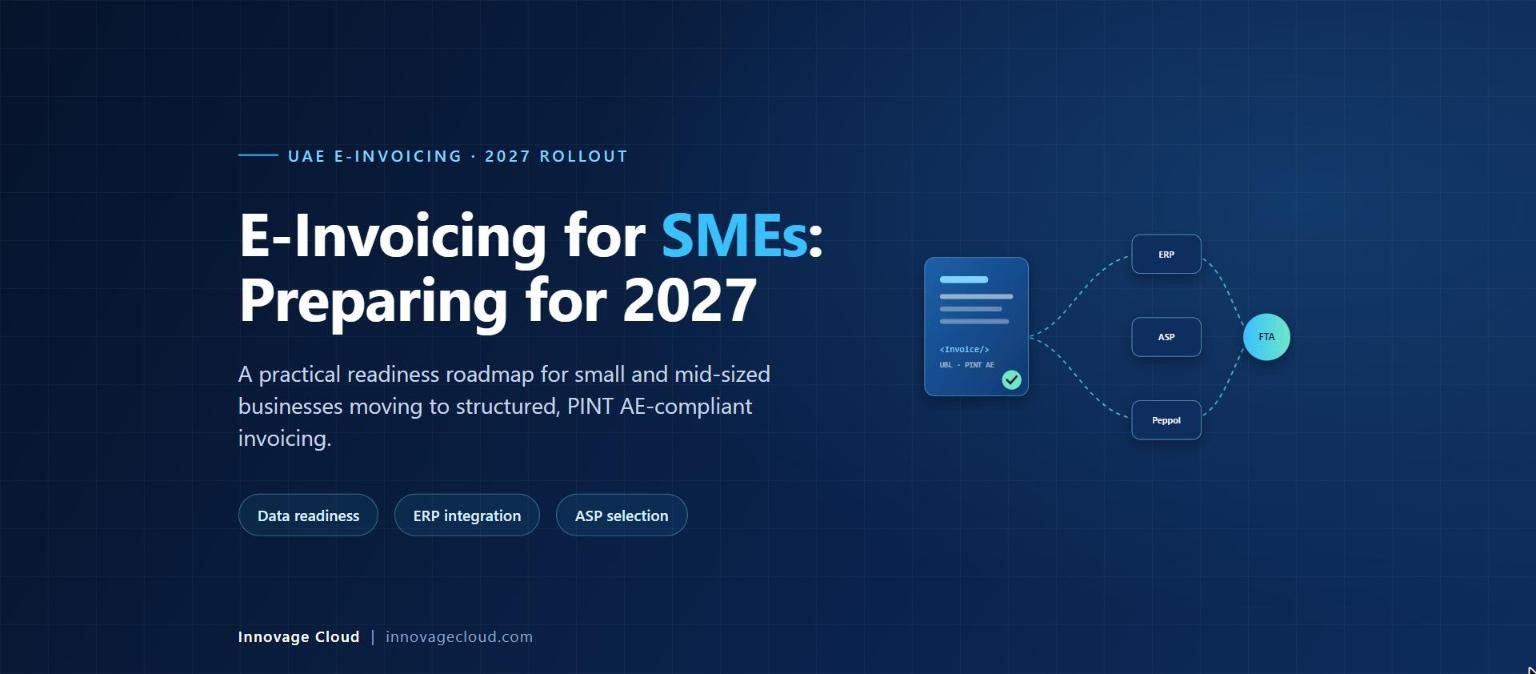
Most of the conversation about e-invoicing in the UAE has focused on large enterprises, because they are first in line. But the bigger story for the UAE economy is what happens next, when thousands of small and medium-sized businesses are expected to move from PDF and paper invoices to structured electronic invoicing. Under the phasing announced so far, businesses with annual revenue below AED 50 million follow the larger companies, with a go-live expected from July 2027 and an earlier deadline to appoint an Accredited Service Provider.
That may sound far away. For a small finance team that already handles VAT returns, payroll, collections and month-end reporting, it is not. This guide explains what changes for SMEs, where smaller businesses usually get stuck, and how to prepare without overspending.
What actually changes for a small business
Today, many SMEs create invoices in accounting software, export them as PDFs and email them to customers. Under the new model, an invoice becomes a structured data file that is sent through an Accredited Service Provider, checked against defined rules and shared with the tax authority. The customer receives the invoice through their own provider rather than as an email attachment.
In practice, three things change for a small business:
- Invoice data must be complete and correct before it leaves your system. Missing or inconsistent details, such as a customer's tax registration number or the wrong tax category, can lead to rejection.
- You will rely on a service provider to send and receive invoices. Choosing that provider becomes a business decision with long-term consequences.
- Your accounting or ERP system needs to produce invoices in the required structured format, either directly or through an integration.
Why SMEs face a different challenge than large companies
Large enterprises usually have dedicated IT teams, ERP specialists and budgets for consultants. SMEs rarely do. The same person who issues invoices may also approve payments, reconcile bank statements and answer customer queries. That makes three issues more serious for smaller businesses.
Data quality. Customer master data in small businesses is often maintained informally. Names are abbreviated, addresses are incomplete and tax registration numbers are missing for some customers. These gaps were tolerated with PDFs, but structured invoices are validated field by field.
Software limits. Some entry-level accounting tools will be updated by their vendors to support the UAE requirements. Others may not, or may support only standard invoices and not credit notes or more complex billing. It is worth asking your software vendor directly what they will support, and when.
Time. SMEs often start late because the deadline seems distant, then try to complete data cleanup, provider selection and testing in a few weeks. That is when mistakes and avoidable costs appear.
A practical preparation timeline for SMEs
You do not need a large project team to prepare well. A small business can work through the following steps over several months, alongside normal operations.
- Confirm your phase and dates. Check your revenue position against the announced thresholds and confirm the latest official timelines with the Ministry of Finance and the Federal Tax Authority, as details can change.
- Review your invoicing software. Ask your vendor whether they will support UAE structured e-invoicing, which document types are covered, and whether they partner with specific service providers.
- Clean your customer and product data. Start with your most frequent customers. Confirm legal names, addresses and tax registration numbers, and make sure every product or service has the correct tax treatment.
- Shortlist service providers. Compare pricing models, support quality, integration options with your software, and how easy it would be to switch later.
- Test real scenarios. Do not test only a simple invoice. Include credit notes, discounts, foreign-currency invoices if you issue them, and what happens when an invoice is rejected.
- Assign ownership. Decide who in the business monitors submissions and fixes rejected invoices after go-live. In a small company, this is often one person, so make sure they have a backup.
If your business runs an ERP rather than simple accounting software, the integration step usually needs more attention. This overview of UAE e-invoicing readiness and ERP integration explains how structured invoice data, field mapping and the connection to a service provider fit together.
Common mistakes to avoid
- Choosing a provider on price alone. The cheapest subscription can become expensive if it does not integrate well with your software or makes switching difficult later.
- Assuming your accountant will handle everything. External accountants can advise on tax treatment, but invoicing data lives in your own systems and processes.
- Ignoring incoming invoices. E-invoicing affects the invoices you receive from suppliers as well as the ones you send. Your accounts payable process will need to handle structured invoices too.
- Leaving testing until the final month. Testing always reveals issues. Leave enough time to fix them calmly.
The opportunity behind the requirement
E-invoicing is a compliance obligation, but it also brings practical benefits for smaller businesses. Structured invoices reduce manual data entry, lower the risk of disputes over invoice details and can speed up payment when customers process invoices automatically. Businesses that prepare early can use the transition to tidy their customer data, simplify invoicing workflows and get a clearer view of their receivables.
For UAE SMEs, the message is simple: the deadline may be in 2027, but the preparation starts now. A few hours each week spent on data, software checks and provider selection will make the difference between a calm go-live and a rushed one.
Note: dates and thresholds are based on published guidance at the time of writing. Always confirm current requirements with the UAE Ministry of Finance and the Federal Tax Authority.
Related Blog



6b066012b5ac2.webp)

6afd7f7f38e72.png)




























6ad6096d44d50.jpg)




6ad1c7874e895.png)



6acdefb0a58d8.jpeg)
























6ab301e068635.jpg)
















6aa847276cd93.png)










6a9fa7a209e73.jpg)






6a98551d6c9c3.png)
































6a7b248dbcf8b.jpeg)












6a6350a4893cb.png)

6a606c6a4b011.jpg)












6a50e9b09fb4e.jpg)















6a2bcd56d8f33.jpg)
6a2c0d1d309d3.jpg)

6a211cc2a7dc0.png)

6a18313161c5a.jpg)





























69cb4b7827b08.webp)


























694fa33ac18ea.jpeg)



693e715695a8f.png)


693923523a9ac.png)








68ec9e22634a4.png)
























68edf1fee9090.jpg)
















68f0a0f5a49dc.png)





















69dcdb1cbe702.jpg)
6aed985f6b5b8.webp)