
The Biggest Marketing Challenges New Business Owners Face — and How to Overcome Them
Starting a new business is exciting. You have a product or service you believe in, a vision for the future, and the ambition to build something of your own.
But once the business launches, one question quickly becomes difficult to answer:
“How do I actually get customers?”
Marketing is often one of the biggest challenges for new business owners. With so many options—social media, Google, SEO, paid advertising, content marketing, email, WhatsApp, and PR—it can be difficult to know where to begin, what to prioritize, and, most importantly, what will actually generate business.
The good news is that marketing does not have to mean doing everything at once. It starts with understanding the most common challenges and building a strategy around them.
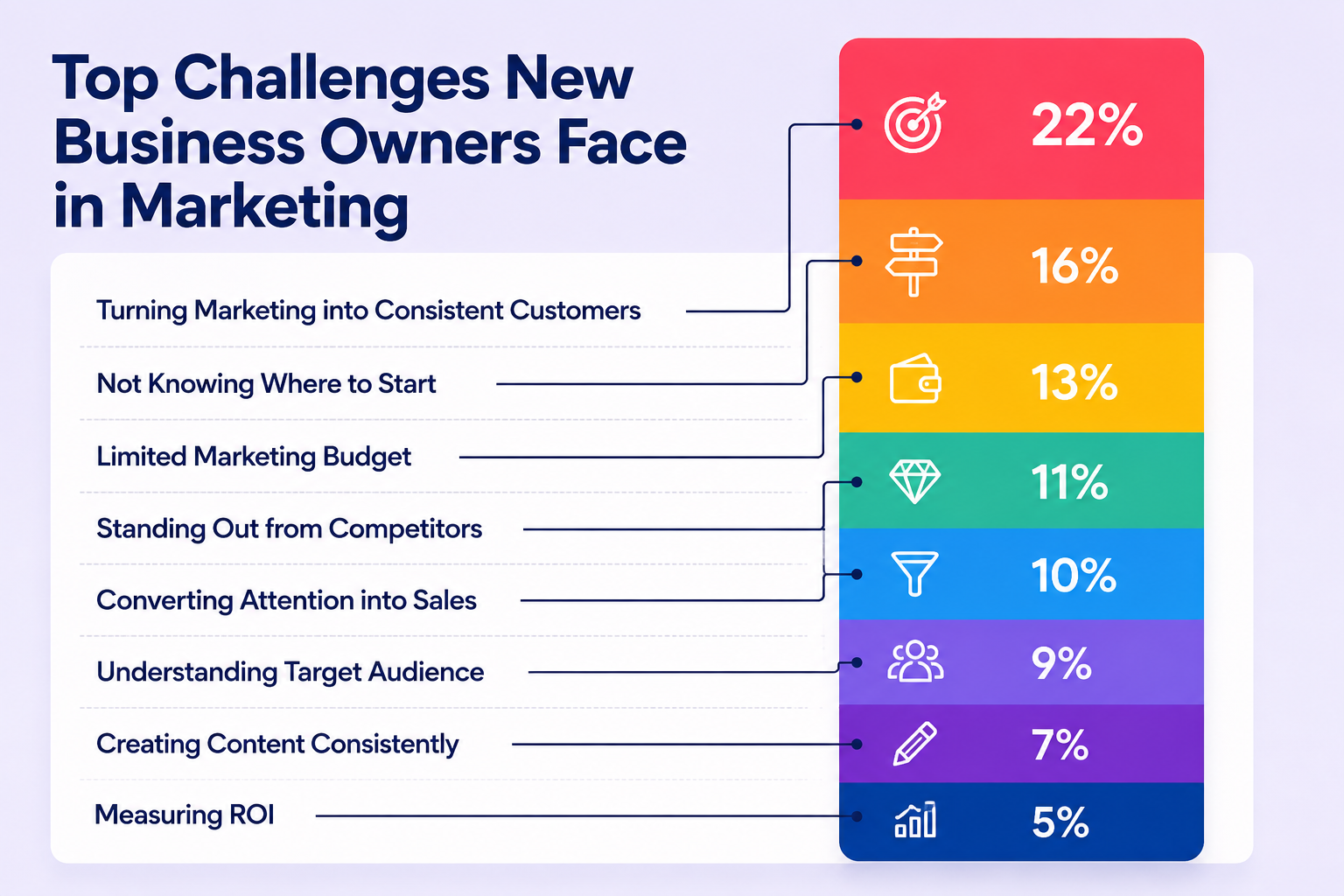
1. Turning Marketing Into Consistent Customers
Having a social media presence is not the same as having a customer acquisition strategy.
Many new businesses spend time creating Instagram posts, running occasional advertisements, or building a website but still struggle to generate inquiries consistently.
The real objective of marketing should be to create a repeatable journey from awareness to inquiry to customer.
This means understanding:
- Who your ideal customer is
- What problem you solve for them
- Where they search for solutions
- What makes them choose your business
- How you will capture and follow up with enquiries
Marketing becomes much more effective when every activity has a purpose beyond simply generating visibility.
2. Not Knowing Where to Start
Should you focus on Instagram? Google Ads? SEO? Your website? Influencers? LinkedIn? Email marketing?
For a new business owner, the number of choices can be overwhelming.
The answer is not to be everywhere.
Instead, identify where your target customers are most likely to discover and evaluate your business and build your initial marketing strategy around those channels.
For example, a local service business may benefit significantly from Google Search and local SEO, while a visually driven consumer brand may gain more traction through Instagram and short-form video.
The right marketing channel is the one that reaches the right customer at the right stage of their buying journey.
3. Working With a Limited Marketing Budget
New businesses rarely have unlimited resources.
Every marketing investment therefore needs to be considered carefully. Spending a large amount on multiple channels without understanding what is working can quickly become expensive.
A better approach is to start with a focused strategy:
Test ? Measure ? Learn ? Optimize ? Scale.
Instead of trying to dominate every platform immediately, identify one or two high-potential channels, establish benchmarks, and measure the results.
A smaller marketing budget with a clear strategy can often outperform a larger budget that is spread too thinly.
4. Standing Out From Competitors
One of the hardest questions for a new business is the following:
“Why should customers choose me instead of everyone else?”
Simply saying that your business provides “quality products,” “excellent service” or “competitive prices” is rarely enough. These claims are made by almost every competitor.
Your marketing needs to communicate your unique value proposition clearly.
Ask yourself:
- What do we do differently?
- Who do we serve particularly well?
- What problem do we solve better?
- Why should customers trust us?
- What experience can we provide that competitors cannot?
Your differentiation should be visible not only in your advertising but also across your website, social media, content, and customer experience.
5. Converting Attention Into Sales
Getting views, likes, and followers can feel rewarding, but these numbers don't necessarily pay the bills.
A successful marketing strategy needs to move people from attention to action.
That action could be:
- Making an enquiry
- Booking a consultation
- Requesting a quotation
- Calling the business
- Visiting the store
- Purchasing online
- Signing up for an offer
Your website and social media content should make the next step obvious.
A strong call-to-action, an easy inquiry process, and fast follow-up can make a significant difference to conversion rates.
6. Understanding the Target Audience
One of the most common mistakes new business owners make is trying to market to everyone.
“Everyone can be my customer” sounds like a good idea, but it makes marketing much harder.
The clearer you are about your ideal customer, the easier it becomes to create relevant messaging.
Think beyond demographics. Understand their
- Needs
- Problems
- Motivations
- Buying behaviour
- Concerns
- Budget
- Decision-making process
When you understand your customer, your marketing becomes less about promoting a product and more about solving a problem.
7. Creating Content Consistently
Many businesses start with enthusiasm.
They create several posts and publish a few videos, and then, a few weeks later, the content becomes inconsistent.
The problem isn't always a lack of ideas. It is often a lack of strategy and structure.
Instead of asking, “What should we post today?" create content around clear themes such as
Educate: Answer common customer questions.
Build trust: Showcase expertise, reviews, results, and experiences.
Engage: Create conversations around relevant topics.
Convert: Explain your services, offers, and reasons to choose you.
Consistent content should ultimately support your wider business objectives rather than simply filling a social media calendar.
8. Knowing Whether Your Marketing Is Working
Perhaps the most important question a new business owner should ask is the following:
“What am I actually getting from my marketing investment?”
Without measurement, it is difficult to know which activities deserve more budget and which should be changed.
Depending on your business, you may want to track:
- Website traffic
- Search visibility
- Leads and enquiries
- Cost per lead
- Conversion rate
- Customer acquisition cost
- Sales generated
- Return on advertising spend
- Repeat customers
Not every marketing result will be immediate, particularly with channels such as SEO and content marketing. But having measurable objectives allows you to understand whether your strategy is moving in the right direction.
Marketing Is Not About Doing Everything
For a new business, marketing can easily become overwhelming.
There are countless platforms, trends, and tactics competing for your attention. But successful marketing isn't necessarily about doing more.
It's about doing the right things consistently.
Start by understanding your customer. Define what makes your business different. Choose the channels where your audience is most likely to be. Create useful content. Make it easy for people to take the next step. And measure what happens.
Over time, marketing should evolve from something you are simply doing into a structured system that supports business growth.
The Bottom Line
Your first marketing strategy doesn't need to be perfect.
It needs to be focused, measurable, and flexible enough to improve.
The businesses that build strong foundations early are better positioned to turn visibility into trust, trust into inquiries, and inquiries into long-term customers.
Good marketing doesn't just help people find your business. It gives them a reason to choose you.
About Me
Hello, I am Annie :)
I help healthcare and luxury brands across the GCC build stronger reputations, communicate with authority, and grow with intention. Over 16 years, I've led brand strategy, PR, crisis communications, online reputation management, CRM, and competitive intelligence, delivering measurable impact across some of the region's most prestigious and high-profile environments. Based in Dubai. Open to senior strategic roles, high-impact collaborations, and conversations worth having.
Related Blog

6ab301e068635.jpg)












6aa847276cd93.png)









6a9fa7a209e73.jpg)






6a98551d6c9c3.png)







































6a7b248dbcf8b.jpeg)










6a6350a4893cb.png)

6a606c6a4b011.jpg)












6a50e9b09fb4e.jpg)

















6a2bcd56d8f33.jpg)
6a2c0d1d309d3.jpg)

6a211cc2a7dc0.png)

6a18313161c5a.jpg)




























69cb4b7827b08.webp)















68ec9e22634a4.png)



























68edf1fee9090.jpg)

















68f0a0f5a49dc.png)






















69dcdb1cbe702.jpg)