
Who Can Notarize Documents in the UAE? A Guide to Notary Public Services in Dubai

Who Can Notarize Documents in the UAE? A Guide to Notary Public Services in Dubai
Legal documents often need to be officially notarized before they can be used for a transaction in the UAE. This may apply to a Power of Attorney, declaration, company document, contract, or other legal instrument.
However, not every person or business that provides document-related services is legally authorized to notarize documents. Understanding who can perform notarization, what the process involves, and when notarization is required can help individuals and businesses avoid delays.
What Is a Notary Public?
A Notary Public is an authorized official who performs specific legal functions relating to documents and signatures.
In Dubai, Notaries Public operate under legislation regulating notarial services in the emirate. Their functions can include notarizing signatures and instruments, verifying the identity of parties, and carrying out other duties assigned under the applicable legislation.
Notarization is different from simply signing a document or having a document translated. A translation office, typing centre, lawyer, or document-clearing company may assist with preparing documents, but this does not automatically mean that the business itself is a Notary Public.
The notarization must be completed through the appropriate authorized channel.
Who Can Notarize a Document in Dubai?
Documents requiring notarization in Dubai may generally be processed through the official Notary Public system or an authorized private notary, depending on the type of document and the applicable procedure.
Dubai has both government notarial services and licensed private notary services operating within the regulatory framework.
The availability of private notary services can make the process more convenient for individuals and companies that require document notarization.
However, applicants should always verify that the service provider is authorized to perform the specific notarial service required.
What Documents Commonly Need Notarization?
The need for notarization depends on the nature of the document and how it will be used.
Common examples include:
Power of Attorney documents
Declarations
Certain contracts
Corporate documents
Company-related authorizations
Legal undertakings
Certain agreements
Documents intended for use before government authorities
Documents that must be legalized or attested for use abroad
A Power of Attorney is one of the most common documents requiring notarization.
For example, a property owner may authorize another person to manage a particular property transaction. A company may authorize an individual to complete specific government or corporate procedures. In each case, the wording of the authorization should accurately reflect the powers being granted.
Notarization vs. Legal Translation
A common misunderstanding is that translating a document makes it legally notarized.
These are two separate processes.
Legal translation involves translating a document from one language into another while maintaining its legal meaning and structure. Notarization, on the other hand, is an official process concerning the execution or authentication of the document.
A document may therefore require both services.
For example, a client may have an English Power of Attorney that needs to be prepared in Arabic and English before being submitted for notarization. The wording should be carefully reviewed to ensure that both versions convey the same legal authority.
What Identification Is Required?
Identification is an important part of the notarization process.
The parties involved may be required to provide valid identification documents, depending on the type of transaction and the applicable procedure. For UAE residents, an Emirates ID may be relevant, while passport information may also be required in certain circumstances.
The names appearing in the document should match the identification documents.
Even a small difference in spelling can create problems when the notarized document is later submitted to a bank, government department, court, property authority, or another organization.
Can Documents Be Notarized Online?
Digital government services have significantly changed the way certain legal transactions can be completed in the UAE.
The Ministry of Justice provides electronic services for certain contracts and legal documents, including Digital Power of Attorney procedures. The relevant process can include electronic submission, identity verification, payment, electronic signing, and issuance of the completed document.
The exact procedure depends on the type of document and the service being used.
Applicants should therefore check the current requirements before starting the process. Not every document or transaction will necessarily follow the same electronic procedure.
What About Private Notaries?
Private Notaries can provide certain notarial services under the applicable regulatory framework.
For individuals and companies, private notary services may offer an alternative channel for completing eligible documents.
However, the fact that a company provides document services does not by itself make it a private notary.
Before proceeding, clients should confirm:
Whether the provider is officially authorized.
Whether the required document falls within its permitted services.
Whether the document requires Arabic legal drafting or translation.
Whether additional government fees apply.
Whether the completed document requires further attestation.
This is particularly important when a document will be used outside Dubai or outside the UAE.
Documents Issued Outside the UAE
Documents originating outside the UAE may require additional authentication before they can be accepted for official use in the country.
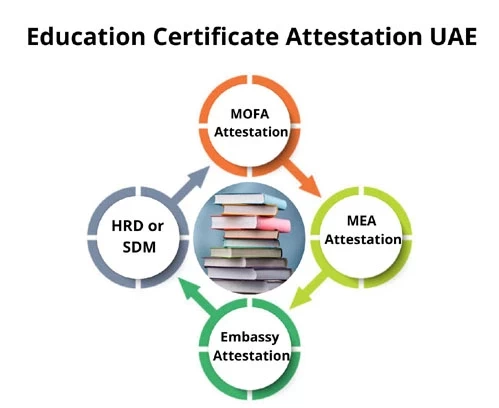
Depending on the country of origin and the purpose of the document, the process may involve notarization or authentication in the country where the document was issued, certification by the relevant authority, UAE Embassy or Consulate attestation, MOFA attestation in the UAE, and legal translation where required.
The exact requirements can differ significantly between documents.
For example, a foreign Power of Attorney intended for use in a UAE property transaction may have different requirements from a foreign educational certificate or corporate document.
It is therefore advisable to identify the final receiving authority before beginning the attestation process.
Common Mistakes When Notarizing Documents
Using the wrong document format
A document prepared for a different jurisdiction may not automatically satisfy UAE requirements.
Incorrect personal information
Names, passport numbers, Emirates ID information, company names, and license details should be checked carefully.
Vague authorization
A Power of Attorney should clearly describe the authority being granted.
Missing supporting documents
Corporate and property transactions may require additional documents.
Ignoring the final purpose
A document intended for use abroad may require additional legalization after notarization.
How to Make the Process Easier
Preparation can make notarization considerably more straightforward.
Before visiting or accessing a notarial service, determine exactly what the document is intended to accomplish. Then collect the relevant identification and supporting documents and review the wording carefully.
If the document is bilingual, compare the Arabic and English versions to ensure that there are no differences in the powers or obligations.
It can also be useful to obtain professional assistance with notary public services in Dubai when the document involves complex legal powers, corporate matters, property transactions, or subsequent attestation requirements. Quick Link provides document preparation, legal translation, notarization, and related document services for individuals and businesses in the UAE.
Conclusion
Notarization is an important part of many legal and administrative transactions in Dubai. While document preparation and translation services can assist with the process, the actual notarial function must be performed through an authorized Notary Public or permitted private notarial channel.
Understanding the difference between document preparation, legal translation, notarization, and document attestation can help individuals and businesses choose the correct procedure.
Before submitting a document, always confirm the requirements of the authority that will ultimately receive it. Proper preparation at the beginning can help prevent rejection, repeated submissions, and unnecessary delays.
Related Blog



6aa847276cd93.png)

















































6a6350a4893cb.png)

6a606c6a4b011.jpg)









6a50e9b09fb4e.jpg)









6a2bcd56d8f33.jpg)
6a2c0d1d309d3.jpg)
6a211cc2a7dc0.png)

6a18313161c5a.jpg)













69cb4b7827b08.webp)















68ec9e22634a4.png)




























68edf1fee9090.jpg)

















68f0a0f5a49dc.png)





















69dcdb1cbe702.jpg)