
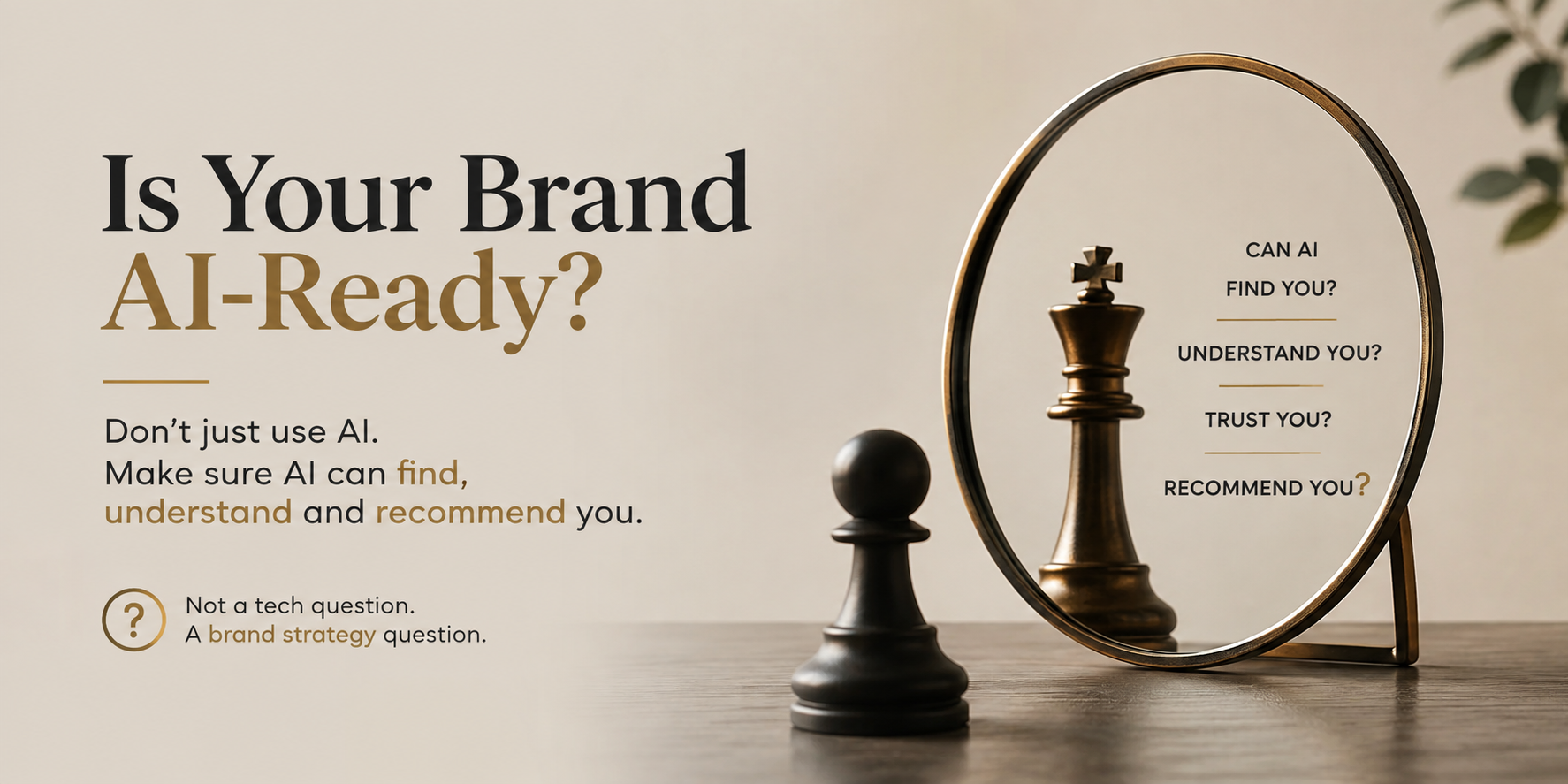
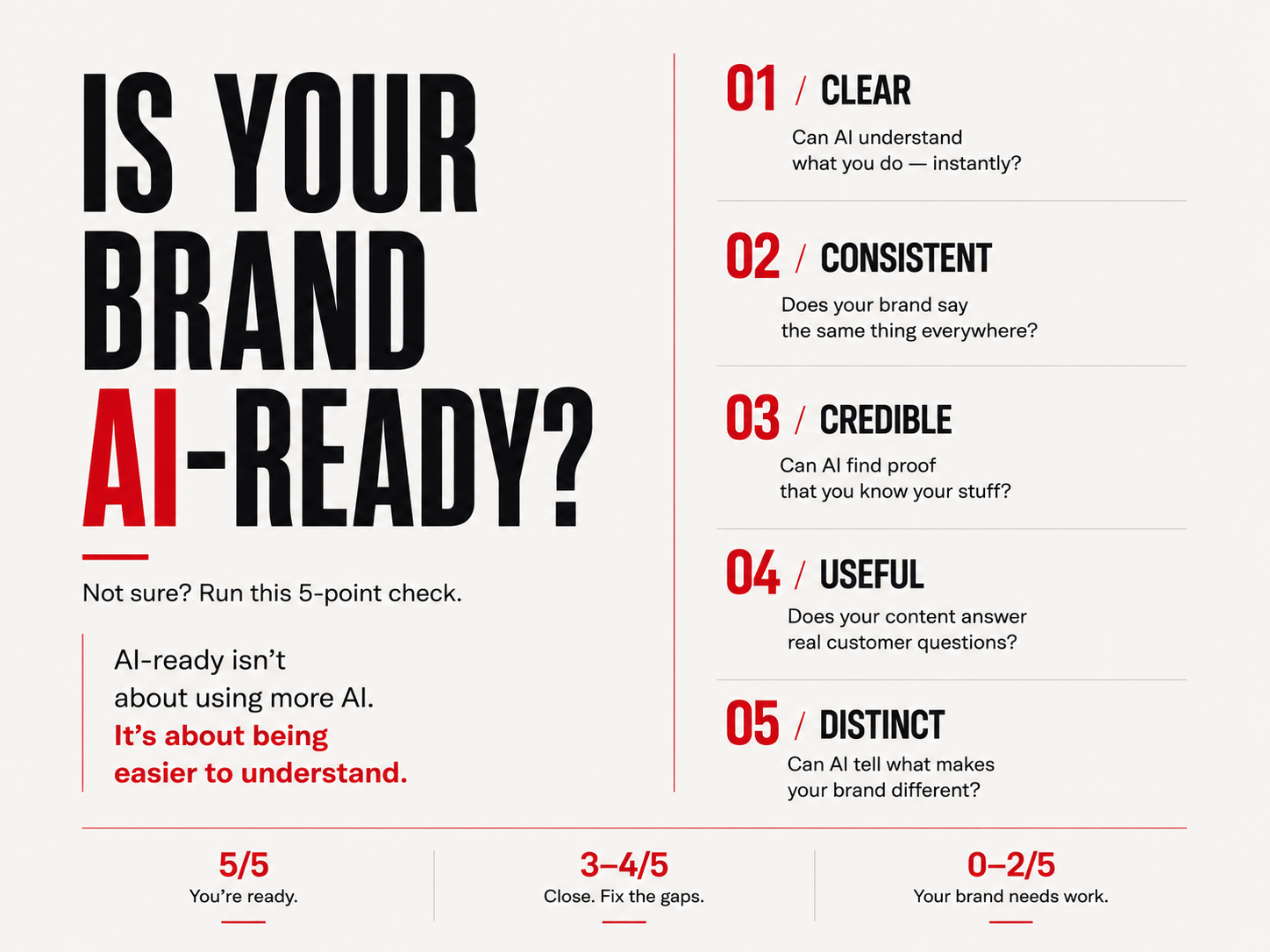
Is your brand AI-ready or are you simply using AI to write captions?
Artificial intelligence has already changed the way businesses create content. It can write captions, generate blogs, create ad copy, analyze data, and even help businesses automate customer interactions.
But there is a much bigger question brands need to be asking:
Is your brand actually AI-ready, or are you simply using AI to write captions?
Because using AI and preparing your brand for an AI-first customer journey are two very different things.
AI Is Changing How People Discover Brands
For years, businesses focused on being visible on Google, Instagram, Facebook, and other traditional digital platforms.
But the way people discover information is changing.
Consumers are increasingly asking AI platforms questions such as the following:
“What is the best clinic for this procedure?”
“Which real estate company should I speak to?”
“What are the best restaurants for this occasion?”
“Which agency can help me with my brand?”
The customer journey is beginning to move from searching for options to asking AI to provide the options.
And that changes the game for brands.
Being visible on Instagram is no longer enough. Ranking on Google is no longer the only measure of digital visibility.
Brands increasingly need to be discoverable, understandable, and credible to AI systems as well.
Enter GEO and AEO
This is where concepts such as Generative Engine Optimization (GEO) and Answer Engine Optimization (AEO) become increasingly important.
But this isn't simply about adding more keywords to your website.
AI needs to understand your business.
It needs to know:
Who are you?
What do you specialize in?
Who do you serve?
What makes you different?
Why should people trust you?
And what evidence supports your claims?
This means the information surrounding your brand becomes increasingly important.
Your website content, expertise, media coverage, reviews, thought leadership, social presence, founder visibility, and other credible sources all contribute to the digital understanding of your brand.
Your Website Needs to Do More Than Sell
A website has traditionally been treated as a digital brochure—a place to showcase services, products, and contact details.
In an AI-driven search environment, it needs to do more.
Your website should provide clear, structured, and authoritative information that helps both people and AI systems understand your business.
That means clearly communicating:
What your business does
Who you serve
What problems you solve
What makes you different
Your areas of expertise
Evidence of your experience
Frequently asked questions
Customer experiences and reviews
Relevant credentials and achievements
The stronger and more consistent this information is across your digital ecosystem, the easier it becomes for AI systems to build a reliable understanding of your brand.
From AI-Powered Search to AI-Powered Customer Journeys
The next shift goes beyond search.
Imagine a customer asking an AI assistant:
“I need a plastic surgeon in Dubai who specializes in this procedure and has extensive experience. Who would you recommend?”
The customer isn't necessarily asking for ten websites to browse.
They are asking AI to help them make a decision.
This is where AI-powered customer journeys and agentic AI become particularly interesting for businesses.
AI could increasingly help customers research, compare, shortlist, and even interact with businesses.
That means brands will need to think beyond the following:
“How do I get the click?”
The more important question becomes:
“What happens when AI becomes part of the decision-making process?”
Agentic AI Will Change Customer Service Too
AI is also moving beyond answering simple questions.
Agentic AI can potentially take on more complex tasks, helping customers navigate processes, make decisions, and complete actions.
For businesses, this could transform areas such as the following:
Customer service
Lead qualification
Appointment booking
Product discovery
Recommendations
Follow-ups
Sales support
Personalised customer journeys
This means your brand strategy and your customer experience strategy can no longer operate completely separately.
If AI is interacting with your customers, it is also interacting with your brand.
But Here's the Paradox: AI Makes Originality More Valuable
There is another side to this conversation that brands cannot ignore.
AI has made content creation incredibly easy.
Anyone can now generate:
A social media caption
A blog
An email
An ad
A product description
A content calendar
So if every competitor is using AI to produce more content, producing more content will not necessarily make your brand more distinctive.
In fact, it could make brands sound increasingly similar.
This is why brand originality and point of view matter more than ever.
AI can help you produce content.
But your
Experience.
Expertise.
Perspective.
Personality.
Reputation.
And point of view (POV) is what makes your brand recognizable.
The New Question for Brands
For years, businesses have asked the following:
“Can people find us online?”
The next question may be
“Can AI understand us well enough to recommend us?”
That requires a much broader approach to brand strategy.
It means thinking about:
Visibility + Authority + Structure + Reputation + Originality + Experience
rather than simply focusing on social media posts or search rankings.
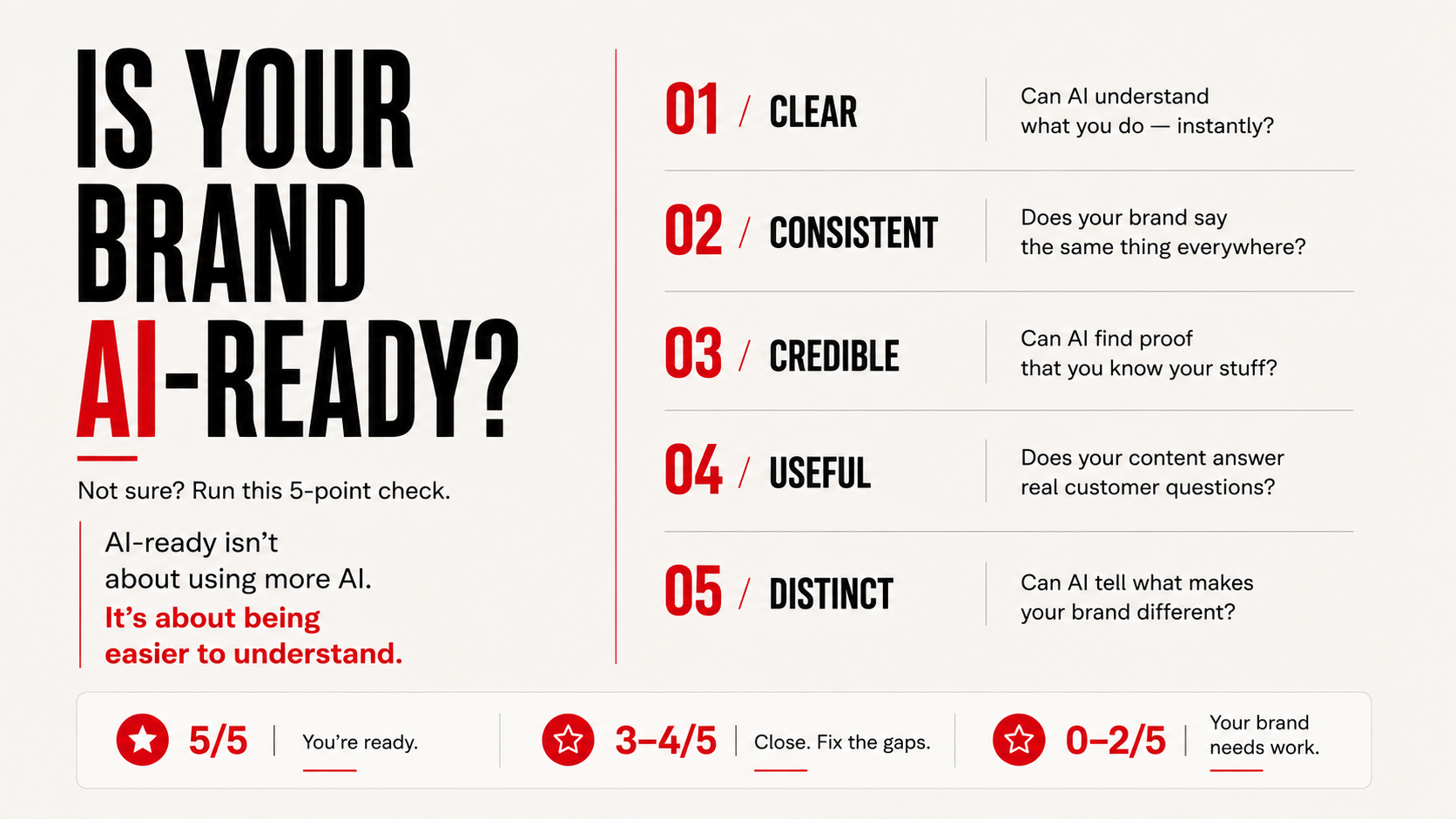
So, Is Your Brand AI-Ready?
Being AI-ready doesn't mean adding another AI tool to your marketing stack.
It means making sure your brand has a clear and consistent digital identity that both humans and intelligent systems can understand.
Ask yourself:
Can AI understand my brand?
Can AI discover my brand?
Can AI verify my brand?
Can AI differentiate my brand from my competitors?
And ultimately:
Can AI confidently recommend my brand?
Because the future of brand visibility isn't just about being seen by people.
It is increasingly about being understood by the technology that helps people make decisions.
And if your brand strategy hasn't started thinking about that yet, now is a very good time to start.
About Me
Annie Rose
Driving Brand Growth & Reputation Across Healthcare, Luxury, F&B & Legal Sectors | GCC/MENA Marketing & PR Leader | Crisis Communications | 16+ Yrs | Dubai
I’m endlessly curious about brands, people, and what makes something truly connect. I love questioning the obvious, spotting what others might miss, and exploring how brands can stay relevant in a world that never stops changing. For me, marketing has never been just about selling. It's about creating meaning, connection, and something people remember.
Annie Rose
Driving Brand Growth & Reputation Across Healthcare, Luxury, F&B & Legal Sectors | GCC/MENA Marketing & PR Leader | Crisis Communications | 16+ Yrs | Dubai
I’m endlessly curious about brands, people, and what makes something truly connect. I love questioning the obvious, spotting what others might miss, and exploring how brands can stay relevant in a world that never stops changing. For me, marketing has never been just about selling. It's about creating meaning, connection, and something people remember.
Related Blog



6ab301e068635.jpg)












6aa847276cd93.png)





6a9fa7a209e73.jpg)




6a98551d6c9c3.png)






























6a7b248dbcf8b.jpeg)










6a6350a4893cb.png)

6a606c6a4b011.jpg)











6a50e9b09fb4e.jpg)













6a2bcd56d8f33.jpg)
6a2c0d1d309d3.jpg)

6a211cc2a7dc0.png)

6a18313161c5a.jpg)


























69cb4b7827b08.webp)










68ec9e22634a4.png)























68edf1fee9090.jpg)













68f0a0f5a49dc.png)















69dcdb1cbe702.jpg)