
Picking a Credit Card in the UAE? Here's What Actually Matters
I've lost count of how many times someone's asked me "which credit card should I get" and then, in the same breath, told me they make AED 5,000 a month and want one of the premium travel cards with unlimited lounge access. It's a nice card. It also needs a salary almost triple that. So before we talk about cashback percentages and lounge access, let's talk about the stuff nobody puts in the ad.
Your salary decides your shortlist before you even open a comparison table.
Banks in the UAE aren't shy about this — every card has a minimum income requirement, and they check it. Entry-level cards, the kind you'll find from Emirates NBD or Mashreq, usually start around AED 5,000 a month. Once you're in the 8,000–15,000 range, the cashback and rewards cards from banks like ADCB and FAB open up. Cross 15,000–25,000 and now you're looking at premium travel cards from the likes of Citi or Emirates Islamic, with lounge access and the works.
Here's the part people skip: applying above your bracket and getting rejected isn't free. It leaves a mark on your Al Etihad Credit Bureau record, and enough of those marks can make your next application harder too. Worth checking the minimum salary before you fall in love with a card you can't get yet.
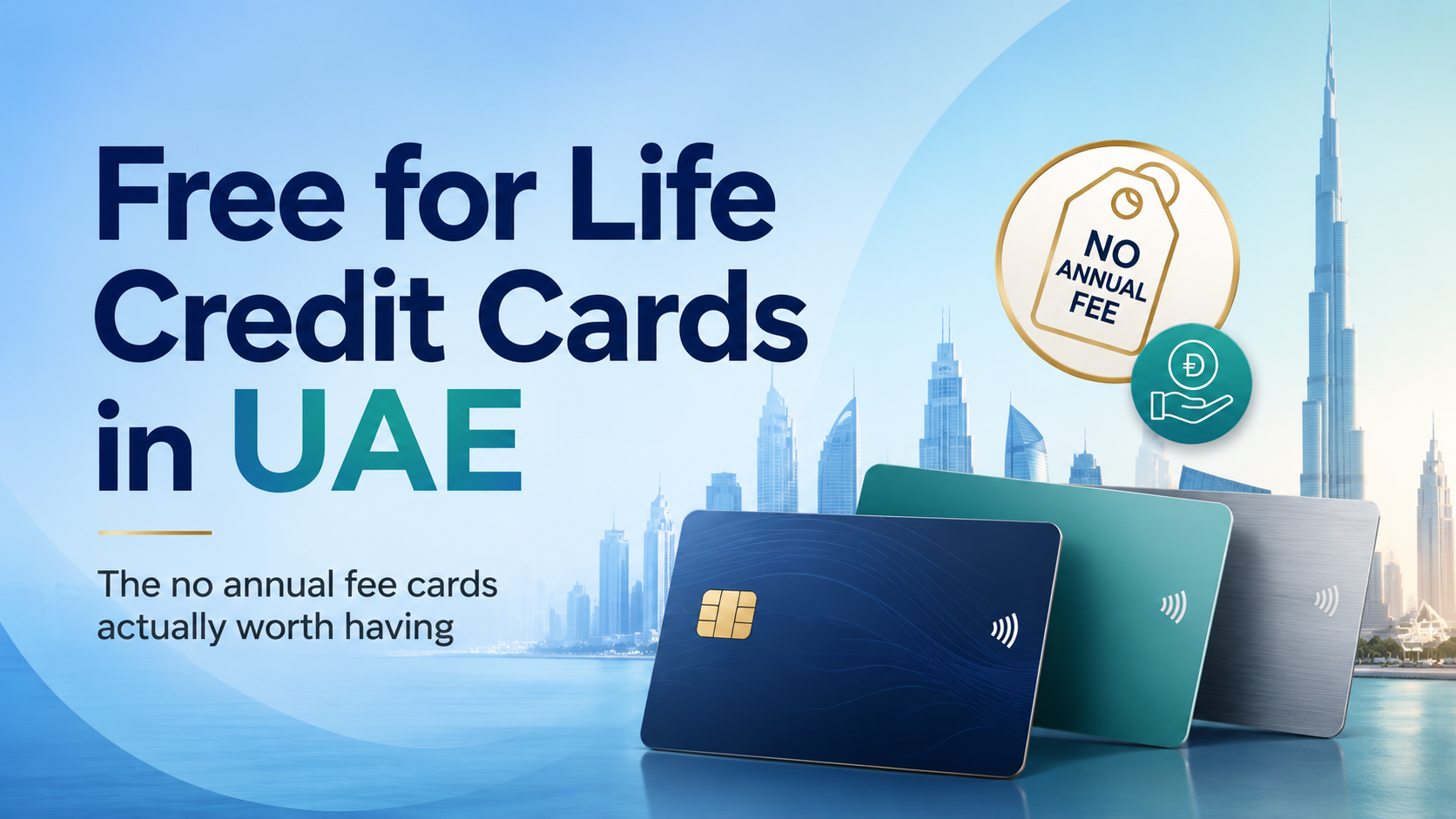
"Free for life" rarely means what it sounds like.
Nearly every bank markets a lifetime-free card these days. Read the actual terms and you'll usually find one of three things going on. Some cards really are free, no strings. Some are free only if you spend a minimum amount every year — often somewhere between AED 12,000 and 36,000 — and quietly start charging you the moment you fall short. And some banks will waive the fee, but only if you call and ask nicely, which isn't the same as a guarantee.
If you're not spending a lot on the card, a genuinely free option beats a "conditionally free" one that surprises you with a AED 300–500 charge a year in.
Match the card to how you actually spend, not how you'd like to spend.
This is the mistake I see most. Someone picks a travel card because the idea of earning miles feels aspirational, but 90% of their spending is groceries, petrol, and school fees — none of which the travel card rewards particularly well. Meanwhile someone else picks a cashback card and then wonders why their two international trips a year cost them a fortune with no lounge access to show for it.
If your spending is steady and local — supermarkets, utilities, everyday stuff — a cashback card usually wins, but check the fine print on category caps. A lot of them advertise 5% cashback that only applies up to a certain monthly spend, then quietly drops to 1% after that.
If you actually travel a few times a year, the annual fee on a proper travel card can pay for itself through lounge access and travel insurance alone — just do the math on whether you'll use those perks often enough to justify it.
And if Sharia compliance matters to you, banks like Emirates Islamic and Dubai Islamic Bank run their cards on a profit-rate structure instead of interest, and most conventional banks — Emirates NBD included — now offer an Islamic version alongside their standard lineup. Worth comparing separately rather than assuming the conventional card is your only option.
Even if you never plan to carry a balance, check the APR anyway.
I get it — nobody thinks they'll miss a payment. But UAE credit card interest rates are usually quoted monthly, not annually, typically landing somewhere between 3.09% and 3.99% a month. Compounded, that adds up fast if a payment slips one month because you were traveling or just forgot. Also worth a quick glance: the grace period (usually around three weeks from your statement date), the late payment fee (commonly in the AED 230–275 range, on top of interest), and the minimum payment requirement, which is often 5% of your balance.
A couple of things people forget entirely.
Supplementary cards for a spouse or family member aren't always free — some banks charge a separate annual fee for them, and it's easy to miss this until the first statement arrives. And if you shop on international websites or travel outside the UAE, foreign transaction fees typically sit around 2.1–2.99% per purchase. A few travel-oriented cards waive this entirely, which is worth knowing if a chunk of your spending happens outside AED.
So which card is "the best"?
Honestly, there isn't one. There's the best card for your salary, your spending pattern, and how disciplined you are about paying on time. The banks' own marketing pages won't tell you where their card falls short — that part's on you to check, ideally by putting a few options side by side on fees, salary requirement, rewards structure, and APR before you apply.
I write about personal finance and banking in the UAE, and I put together Credit Card Finder UAE to make exactly this kind of comparison easier — matching cards to salary and spending habits across the major UAE banks, without the marketing gloss.
Related Blog



6ab301e068635.jpg)












6aa847276cd93.png)











6a9fa7a209e73.jpg)






6a98551d6c9c3.png)


































6a7b248dbcf8b.jpeg)












6a6350a4893cb.png)

6a606c6a4b011.jpg)












6a50e9b09fb4e.jpg)
















6a2bcd56d8f33.jpg)
6a2c0d1d309d3.jpg)

6a211cc2a7dc0.png)

6a18313161c5a.jpg)


























69cb4b7827b08.webp)














68ec9e22634a4.png)























68edf1fee9090.jpg)













68f0a0f5a49dc.png)




















69dcdb1cbe702.jpg)