
Heavy Plate Rolling for Industrial Projects: What Buyers Should Know
Introduction
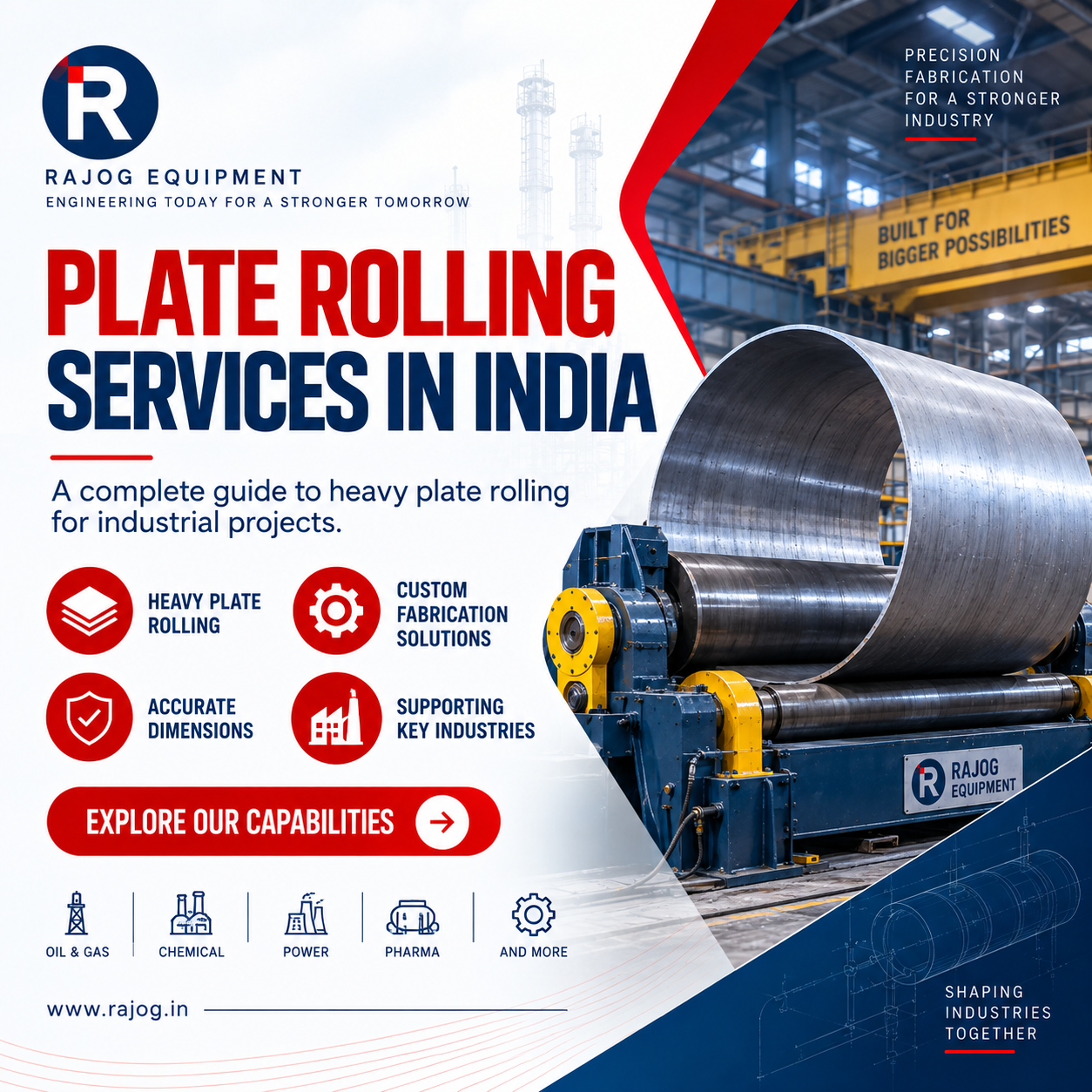
Heavy plate rolling is an important metal-forming process used in the fabrication of large industrial components. From pressure vessels and storage tanks to heat-transfer equipment and heavy engineering structures, accurately rolled plates form the foundation of many critical assemblies.
For industrial buyers in the UAE and across the Gulf region, selecting the right plate rolling partner involves more than simply checking whether a supplier owns a rolling machine. Material thickness, plate dimensions, rolling diameter, forming accuracy, welding requirements, inspection procedures, and overall fabrication capability can all influence the success of a project.
Understanding these factors can help buyers evaluate suppliers more effectively before placing an order.
What Is Heavy Plate Rolling?
Heavy plate rolling is a manufacturing process in which flat metal plates are gradually formed into cylindrical, curved, or conical shapes using specialized rolling equipment.
The process is commonly used when large-diameter shells or curved components are required for industrial fabrication. Depending on the project, plates may be rolled into sections that are subsequently welded, machined, inspected, and assembled into larger equipment.
The quality of the rolling operation is important because inaccurate forming can create problems during welding, assembly, machining, and final dimensional inspection.
Why Plate Rolling Matters in Industrial Fabrication
Plate rolling is often one of the early stages of manufacturing large fabricated equipment. The accuracy achieved during this stage can influence several downstream operations.
A reliable plate rolling process can help with:
- Consistent cylindrical and curved shapes
- Better fit-up during welding
- Reduced dimensional correction
- Improved fabrication efficiency
- More predictable assembly
- Better control of final component dimensions
For large industrial projects, these factors can contribute to smoother fabrication and fewer delays during later manufacturing stages.
What Should Buyers Check Before Choosing a Supplier?
Industrial buyers should evaluate several technical factors before selecting a plate rolling service provider.
1. Plate Thickness and Rolling Capacity
One of the first questions to ask is whether the supplier can handle the required plate thickness, width, length, and material.
Heavy industrial projects may require significantly thicker plates than conventional fabrication work. Buyers should therefore compare the supplier's actual equipment capacity with the project's technical requirements rather than relying only on general claims about heavy fabrication.
2. Required Rolling Diameter
The finished diameter of a rolled component is another important consideration.
Different projects may require large-diameter shells, smaller cylindrical sections, or specific curved profiles. The supplier should have suitable equipment and experience for producing the required geometry while maintaining dimensional consistency.
3. Material Expertise
Plate rolling requirements can vary depending on the material being processed.
Carbon steel, stainless steel, alloy steel, and other engineering materials can have different forming characteristics. A supplier should understand the material specifications and apply suitable forming practices to minimize defects, distortion, or unnecessary rework.
4. Forming Accuracy
Dimensional accuracy is critical for components that will later be welded, machined, or assembled.
Buyers should ask how the supplier controls plate alignment, curvature, roundness, and final dimensions. Proper measurement and inspection procedures can help identify deviations before the component moves to the next manufacturing stage.
Plate Rolling for Pressure Vessel Fabrication
Pressure vessel manufacturing is one of the major applications where plate rolling plays an important role.
Large plates may be rolled into cylindrical shell sections before welding and further fabrication. The shell geometry needs to meet the project's engineering drawings and manufacturing requirements so that subsequent welding, nozzle installation, machining, and inspection can be completed efficiently.
For this reason, buyers sourcing pressure vessel fabrication should consider whether the supplier can provide an integrated fabrication process rather than treating plate rolling as an isolated service.
Welding and Post-Rolling Operations
Plate rolling is normally part of a larger manufacturing workflow.
After rolling, components may require longitudinal or circumferential welding, dimensional inspection, machining, surface treatment, or assembly. Coordination between these operations can reduce handling and improve production efficiency.
An experienced heavy engineering supplier should therefore be able to explain how rolled components move through the complete fabrication process and how dimensional control is maintained at each stage.
Quality Control and Inspection
Quality assurance is an important consideration when purchasing heavy plate rolling services.
Depending on project requirements, buyers may need documentation related to material certificates, dimensional inspection, welding procedures, non-destructive testing, and final quality checks.
Before placing an order, buyers should clarify:
- Required inspection standards
- Material certification requirements
- Dimensional tolerances
- Welding and NDT requirements
- Inspection documentation
- Final acceptance criteria
Clear quality requirements at the quotation stage can help avoid misunderstandings later in the project.
Integrated Manufacturing Capabilities
For complex industrial projects, it can be useful to work with a supplier that provides multiple manufacturing capabilities under one coordinated system.
Plate rolling may need to be combined with heavy fabrication, pressure vessel manufacturing, CNC machining, tube sheet production, cutting, welding, and material handling.
An integrated supplier can simplify communication between different manufacturing stages and make it easier for buyers to coordinate project requirements.
For buyers evaluating potential suppliers, reviewing their heavy engineering and fabrication capabilities can provide a broader understanding of the manufacturing support available for complex industrial projects.
What Information Should Buyers Include in an RFQ?
A detailed Request for Quotation (RFQ) helps suppliers provide more accurate technical and commercial proposals.
Buyers should ideally include:
- Material grade
- Plate thickness
- Plate width and length
- Required finished diameter
- Component drawings
- Required tolerances
- Quantity
- Welding requirements
- Inspection requirements
- Applicable standards
- Required documentation
- Delivery expectations
Providing this information at the beginning allows the supplier to assess manufacturing feasibility and prepare a more relevant quotation.
Supporting Industrial Projects Across Different Sectors
Heavy plate rolling is used across a wide range of industrial applications. These include pressure equipment, oil and gas projects, chemical processing, power generation, heat-transfer equipment, water and desalination systems, fertilizers, steel plants, cement plants, and other heavy engineering applications.
The exact manufacturing process depends on the component design, material, dimensions, and project specifications.
Conclusion
Choosing a heavy plate rolling supplier should be based on technical capability, manufacturing capacity, dimensional control, material expertise, quality processes, and the supplier's ability to support related fabrication operations.
For Gulf and international industrial buyers, evaluating these factors before requesting a quotation can make supplier comparison more structured and help reduce manufacturing risks.
A capable plate rolling partner should not only be able to form heavy plates but also understand how those components fit into the wider fabrication and engineering process.
For industrial projects requiring coordinated fabrication and engineering support, reviewing the supplier's overall manufacturing capabilities can be an important part of the procurement process.
Related Blog


6aa847276cd93.png)









































6a6350a4893cb.png)
6a606c6a4b011.jpg)









6a50e9b09fb4e.jpg)




6a2bcd56d8f33.jpg)
6a2c0d1d309d3.jpg)
6a211cc2a7dc0.png)

6a18313161c5a.jpg)











69cb4b7827b08.webp)















68ec9e22634a4.png)



















68edf1fee9090.jpg)












68f0a0f5a49dc.png)




















69dcdb1cbe702.jpg)