
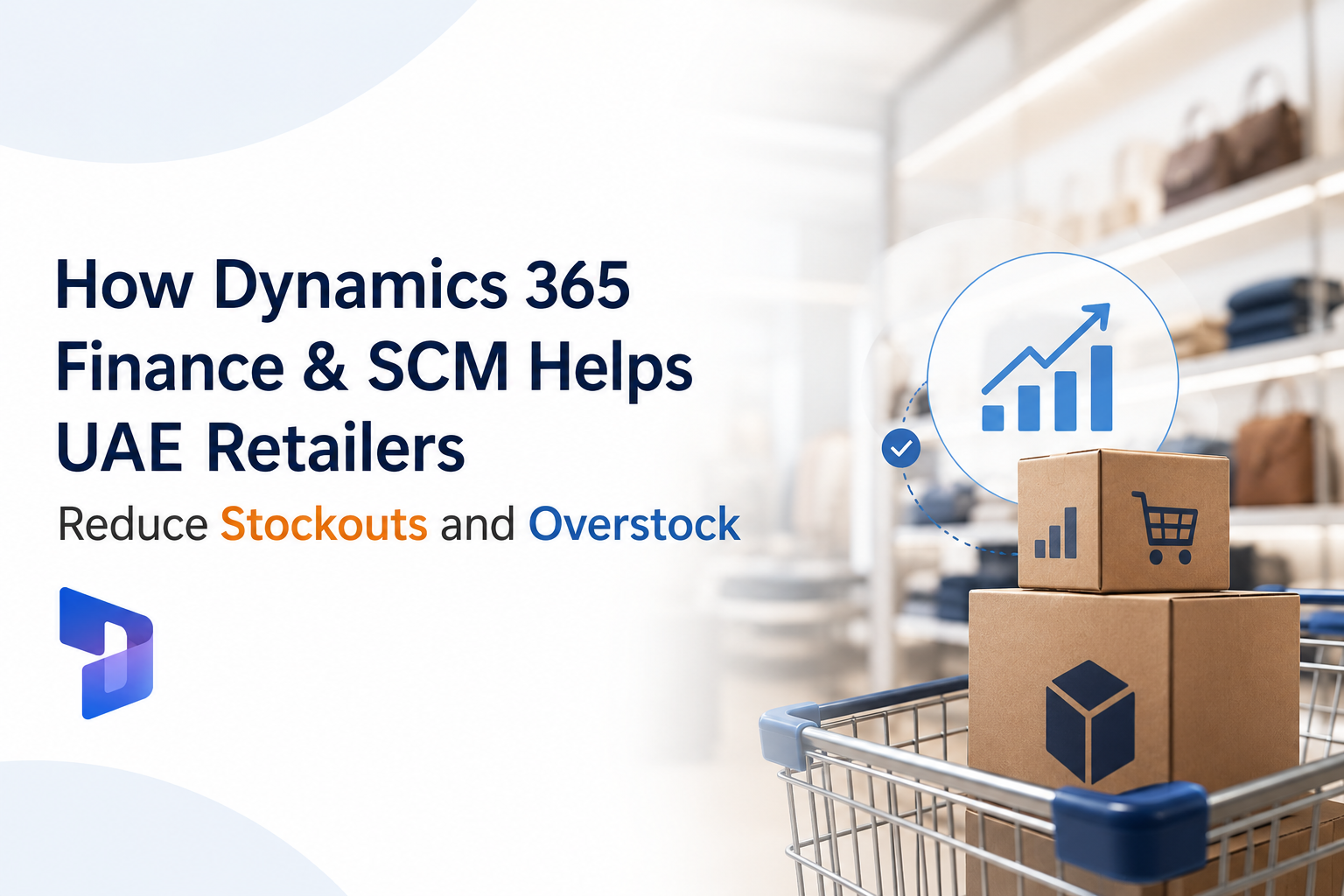
How Dynamics 365 Finance & SCM Helps UAE Retailers Reduce Stockouts and Overstock
For retailers, having the right products available at the
right time is critical to protecting revenue and customer loyalty. Yet
stockouts and excess inventory remain common challenges, particularly for
businesses managing multiple stores, warehouses, suppliers, and online sales
channels.
A stockout can result in missed sales and frustrated
customers, while excess inventory ties up working capital and can eventually
lead to markdowns. For UAE retailers operating in a highly competitive market,
improving inventory accuracy and demand planning is becoming increasingly
important.
Microsoft Dynamics 365 Finance & Supply Chain Management
helps retailers connect inventory, procurement, demand forecasting, warehouse
operations, and financial data. This connected approach can help businesses
improve inventory decisions while reducing the operational and financial impact
of stockouts and overstock.
Why Stockouts and Overstock Are Costly for UAE Retailers
Stockouts and overstock may appear to be opposite problems,
but they often have the same underlying cause: insufficient visibility into
demand and inventory.
UAE retailers face several retail
inventory management challenges, including conflicting inventory data,
siloed sales channels, manual processes, inaccurate demand forecasting, and
limited visibility across stores and warehouses. These issues can become more
difficult to manage as retailers expand across locations and digital channels.
Common causes of stockouts include:
- Inaccurate
demand forecasts
- Delayed
replenishment
- Poor
inventory visibility
- Supplier
delays
- Unexpected
demand increases
- Inefficient
warehouse processes
Excess inventory can result from:
- Overestimating
customer demand
- Purchasing
without current sales data
- Slow-moving
products
- Poor
inventory allocation
- Seasonal
demand changes
- Limited
visibility across locations
For businesses looking for retail inventory management
software in UAE, the ability to connect these operational factors is essential.
Get Real-Time Inventory Visibility
One of the biggest challenges for multi-location retailers
is knowing exactly where inventory is available.
A product may be sitting in one store while another location
is experiencing a stockout. Without centralized information, employees may not
have enough visibility to move inventory efficiently.
Dynamics 365 inventory management provides a connected view
of inventory across relevant locations and operations. Retailers can use
current inventory information to understand stock levels and make more informed
replenishment and allocation decisions.
This can help businesses:
- Monitor
inventory levels
- Identify
low-stock products
- Track
inventory across locations
- Improve
replenishment planning
- Reduce
unnecessary purchases
- Make
better allocation decisions
Real-time information also gives decision-makers greater
confidence when planning purchases and fulfilling customer orders.
Improve Demand Forecasting With AI
Forecasting demand is one of the most important parts of
inventory planning. Retail demand can change because of promotions, holidays,
customer trends, seasonality, and changing market conditions.
This is particularly relevant in the UAE, where demand can
shift significantly around periods such as Ramadan, White Friday, and the Dubai
Shopping Festival. Without dynamic forecasting, retailers can face either
excess stock or shortages during important sales periods.
With AI-powered demand forecasting, Dynamics 365 can help
businesses analyze relevant data and identify demand patterns. This gives
planners better information for purchasing and replenishment decisions.
Instead of relying entirely on assumptions or historical
averages, retailers can use data-driven insights to improve their inventory
planning.
Better forecasting can help retailers work toward:
- Lower
excess inventory
- Fewer
stockouts
- Improved
product availability
- Better
purchasing decisions
- More efficiently
working capital management
Automate Replenishment Decisions
Replenishment becomes increasingly complex when retailers
manage multiple stores and warehouses.
Manually checking stock levels and creating purchase
requirements can consume significant time. It can also increase the risk of
delayed replenishment.
Dynamics
365 Supply Chain Management for retail can support structured replenishment
processes based on inventory requirements and demand information.
Retailers can use the platform to establish more consistent
approaches to:
- Reorder
planning
- Purchase
requirements
- Inventory
replenishment
- Warehouse
transfers
- Safety
stock management
Automated reorder processes and real-time inventory
information can help retailers move from reactive inventory management toward
more proactive control.
Balance Inventory Across Multiple Stores
Having enough inventory across the business does not
necessarily mean every store has the right inventory.
For example, one UAE store may have excess stock of a
product while another location has limited availability. If retailers cannot
identify this imbalance quickly, they may purchase additional inventory
unnecessarily.
Centralized inventory visibility can help businesses make
more informed decisions about moving products between locations.
This can improve inventory utilization while reducing
unnecessary procurement.
For retailers operating across Dubai, Abu Dhabi, Sharjah,
and other locations, this type of visibility can become increasingly valuable
as the business expands.
Reduce Excess Inventory and Markdown Risk
Excess inventory affects more than warehouse space. It can
tie up capital, increase storage costs, and reduce profitability.
Products that remain unsold for extended periods may
eventually require discounts or promotional campaigns to clear stock. Poor
inventory visibility can also encourage businesses to over-order simply to
avoid potential stockouts.
By combining retail demand forecasting, inventory
visibility, and financial information, retailers can better understand which
products are moving quickly and which may require attention.
This can support earlier decisions around:
- Purchasing
- Promotions
- Inventory
transfers
- Product
assortment
- Pricing
- Replenishment
The goal is not simply to reduce inventory. It is to
maintain the right inventory level to meet customer demand without
unnecessarily tying up working capital.
Connect Inventory With Finance
Inventory decisions directly affect financial performance.
Purchasing too much inventory increases working capital requirements, while
stockouts can reduce revenue opportunities.
With Dynamics 365 Finance for retail, businesses can connect
operational and financial information to gain a broader understanding of
inventory costs and profitability.
Retailers can evaluate inventory decisions alongside
financial metrics rather than managing supply chain and finance as completely
separate functions.
This connected approach can support better visibility into:
- Inventory
costs
- Purchasing
expenses
- Product
margins
- Working
capital
- Cash
flow
- Financial
performance
It can also help reduce discrepancies between inventory
activity and financial reporting, an important consideration for retailers
managing UAE VAT and compliance requirements.
Improve Warehouse and Fulfilment Operations
Inventory accuracy also depends on warehouse efficiency.
Receiving, picking, packing, movement, and fulfilment processes all influence
how quickly products become available to customers.
Dynamics 365 warehouse management can help retailers create
more structured and connected warehouse workflows across multiple sites. This
can support better inventory control and more efficient fulfilment.
For businesses managing physical stores and e-commerce
orders, connecting warehouse and inventory processes can also help make better
use of available stock.
Intelligent fulfilment capabilities can help retailers
determine where orders should be fulfilled based on inventory availability and
operational requirements.
Build a More Responsive Retail Supply Chain
Reducing stockouts and overstock requires more than better
inventory software. Retailers need visibility across demand, inventory,
procurement, warehouses, suppliers, and finance.
Dynamics 365 Finance & Supply Chain Management for
retail brings these areas together, helping businesses move from reactive
inventory management toward more connected and data-driven decision-making.
The platform can support:
- Real-time
inventory visibility
- Demand
forecasting
- Procurement
automation
- Warehouse
management
- Inventory
replenishment
- Intelligent
fulfilment
- Financial
visibility
This connected approach is particularly valuable for
retailers that have outgrown spreadsheets, standalone inventory tools, or
disconnected ERP systems.
Turn Inventory Management Into a Competitive Advantage
For UAE retailers, inventory directly influences customer
satisfaction, revenue, cash flow, and profitability. Stockouts can result in
lost sales, while excess inventory can consume capital and increase markdown
pressure.
A modern retail ERP system in UAE can provide the visibility
and automation needed to manage these challenges more effectively.
Dynamics 365 Finance & Supply Chain Management connects
inventory, forecasting, procurement, warehouse management, fulfilment, and
finance within a unified environment.
If your business is experiencing recurring stockouts, excess
inventory, inaccurate forecasting, or fragmented inventory data, it may be time
to evaluate a more connected approach.
Explore how DynamicsSmartz
can help your UAE retail business implement and optimize Dynamics 365 Finance
& Supply Chain Management for better inventory visibility, planning, and
operational efficiency.
Related Blog

6ab301e068635.jpg)












6aa847276cd93.png)








6a9fa7a209e73.jpg)






6a98551d6c9c3.png)

































6a7b248dbcf8b.jpeg)











6a6350a4893cb.png)

6a606c6a4b011.jpg)












6a50e9b09fb4e.jpg)

















6a2bcd56d8f33.jpg)
6a2c0d1d309d3.jpg)

6a211cc2a7dc0.png)

6a18313161c5a.jpg)



























69cb4b7827b08.webp)















68ec9e22634a4.png)


























68edf1fee9090.jpg)
















68f0a0f5a49dc.png)





















69dcdb1cbe702.jpg)