
Polite Expressions Saying Yes in Emirati Arabic in Legal and Business Contexts
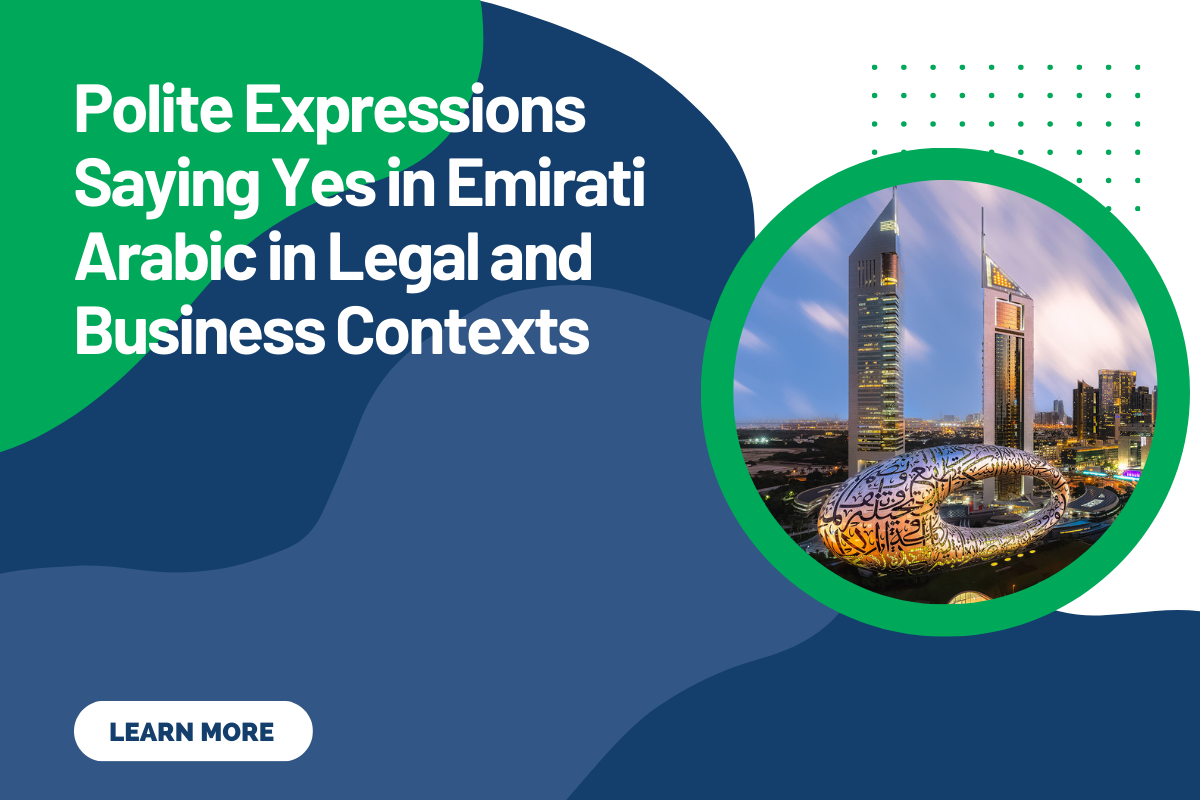
Polite Expressions Saying Yes in Emirati Arabic in Legal and Business
Contexts
Getting agreement right shapes trust, pace, and
outcomes. When people ask how to say yes in Emirati Arabic, they often
want more than a literal word. They want tone, respect, and clarity that fit a
boardroom in Dubai or a courtroom exchange. This guide maps common options,
when to use them, and how to avoid mix-ups. It stays close to real meetings,
filings, and emails you see across the UAE. It also shows how to align spoken
replies with written approvals so deals and procedures keep moving with no
drama.
Why This Topic Matters
In practice, saying yes has layers. You confirm you
heard, you agree with terms, and you accept next steps. One word rarely covers
all three. Many businesses learn this the hard way when a polite nod did not
mean approval, or when a firm yes sounded too blunt for a senior audience.
In legal work, a precise yes protects records. In
business, the right yes keeps relationships steady while plans change. With
Emirati Arabic phrases, you can show respect, signal timing, and confirm scope.
Small shifts in phrasing help people understand what will happen and when.
Core Polite Ways to Say Yes in Meetings
na'am: A clear yes, polite and slightly formal.
It fits executive meetings, press interviews, and public comments. Use it when
you want to sound professional and direct without sounding casual.
aywa and ee: Friendly yes forms used in
many everyday exchanges. They feel warm and relaxed. In cross-functional
meetings, these can soften the room, but pair them with a follow-up like
“noted” or “we will proceed” for clarity.
tamam and mashi: Both mean “okay” or “all
right.” These accept a plan or confirm understanding. In workshops and vendor
calls, many people use them to keep momentum. Add a time or action next to them
so no one guesses what happens next.
tab'an: Means “of course.” It signals strong
agreement and readiness to help. It works well when you agree in principle or
want to show support without changing the scope yet.
Formal Yes for Legal and Compliance
Records and hearings need crisp consent. na'am
remains safest for a clean yes on the record. It leaves little room for reading
between the lines, which helps when minutes, affidavits, or approvals get
reviewed later.
sam'an wa ta'atan: Literally “heard and will
obey.” It expresses respectful compliance. Use it with caution. It suits
instructions or procedural orders, not equal-footing negotiations. In
transcripts, it shows you accept the instruction as given.
hader: Often used as “at your service” or
“certainly.” It works when you receive a directive and will act. Many teams use
it to confirm they will implement a step that was already agreed and
documented.
Soft Yes and Everyday Signals like Yalla
inshallah: Common and respectful. It can mean yes
with timing or conditions implied. In business, people sometimes hear it as a
soft yes or a maybe. Pair it with clear dates or deliverables, or choose a
firmer term if the plan is locked.
yalla in everyday talk means “let’s go” or “come
on.” So the phrase “yalla Emirati Arabic” does not stand in for a yes by
itself. It can follow a yes to push action, like “na'am, yalla.” Alone, it
sounds like a prompt, not a decision.
khalas and tamm: Both suggest “done” or
“all set.” They can close a small task or mark finality. In legal or
high-stakes calls, use them alongside a clear record of what is actually done
to avoid scope drift.
Email and Written Approvals
In email, keep yes tight and auditable. For formal
confirmations, write “Na’am, we approve the attached terms,” or “Approval
granted for item 3 as discussed on 12 Sept.” Then list what you approve and by
whom. This links speech to a paper trail.
For softer coordination emails, “Tamam, proceeding with
phase one” keeps tempo upbeat but still clear. If timing is uncertain, swap in
a firm date instead of “soon.” For broader context on phrasing across
languages, many teams refer to The Complete Guide to English to Emirati Arabic
Translation for Personal, Business, and Legal Use in Dubai when aligning
templates.
Practical Workflow with an Emirati Arabic Translator
In real projects, clarity grows from workflow, not just
words. Share agendas and draft terms with your interpreter before a session.
Flag where you need a firm yes versus a supportive yes. This avoids accidental
over-commitment in live talk.
Businesses such as "Q Links Legal Translation
Services" often approach this strategically. They set a short
pre-brief, define tone, and agree on how to echo approvals in both Arabic and
English. That way, what people hear matches what the record shows.
If you need formal phrasing that stands up in procedures
or filings, a specialized resource on yes in Emirati Arabic can help align spoken
intent with acceptable legal wording in Dubai contexts.
Step-by-Step Framework: Choose the Right Yes
1.
Define the purpose: Are you confirming
receipt, agreeing to terms, or accepting an instruction? Match phrasing to the
goal.
2.
Gauge formality: Senior officials or
legal records call for formal terms like na'am. Teams and workshops can use
aywa or ee with a clarifier.
3.
Lock scope: Right after the yes, list
what is included. Use item numbers, dates, or version names.
4.
Set timing: Replace vague words with a
date or milestone. This turns a soft yes into a plan.
5.
Mirror it in writing: Follow a verbal yes
with a short email that repeats the decision and the scope in simple lines.
6.
Review the record: Check minutes,
transcripts, or tickets so the yes in speech matches the yes on paper.
7.
Close the loop: If any part changed, send
an update with “Revised approval” in the subject and list the change.
Comparison Table: Contexts and Phrases
Matching setting, aim, and tone for approvals
|
Context |
Aim |
Safer phrase |
Notes on tone |
|
Executive meeting |
Agree on direction |
na'am, tab'an |
Formal, respectful |
|
Vendor call |
Confirm next step |
tamam, mashi |
Casual but clear |
|
Legal instruction |
Acknowledge order |
na'am, hader |
Record-friendly |
|
Negotiation |
Yes with limits |
na'am, scope is A only |
State limits right away |
|
Team stand-up |
Move forward now |
aywa, yalla |
Energy and pace |
|
Email approval |
Written consent |
Approval granted for X |
Time stamp and sign-off |
FAQs
1.
What is the most neutral way to say yes in
formal settings? Use na'am.
It is clear, polite, and works well in minutes, transcripts, and official
notes.
2.
Is aywa acceptable in business meetings? Yes,
in many internal or informal meetings. Add a follow-up line that confirms the
action or scope so no one guesses.
3.
Does inshallah mean a firm yes? Not
always. It can signal intent with timing or conditions. For firm approval, use
a direct yes plus dates.
4.
What about yalla Emirati Arabic? Yalla
means “let’s go.” It can follow a yes to prompt action. By itself, it is not an
approval.
5.
How do I avoid confusion in writing? Repeat
the yes in email, list what you approve, add dates, and include who is
responsible. Keep it short.
6.
When should I involve an Emirati Arabic
translator? When
the record must be exact, such as contracts, court matters, or compliance-heavy
processes.
7.
What if I need a supportive yes without
over-committing? Try
tab'an to show goodwill, then state your limits or next review point right
away.
Conclusion
Saying yes travels across people, records, and time. The
right expression makes promises real and traceable. Whether you use na'am in a
hearing, tamam in a sprint review, or a careful email sign-off, shape your yes
around purpose, tone, and scope. With a steady framework and clear writing, yes
in Emirati Arabic becomes both polite and precise.
Related Blog

6ab301e068635.jpg)









6aa847276cd93.png)







6a9fa7a209e73.jpg)





6a98551d6c9c3.png)




































6a7b248dbcf8b.jpeg)











6a6350a4893cb.png)

6a606c6a4b011.jpg)












6a50e9b09fb4e.jpg)














6a2bcd56d8f33.jpg)
6a2c0d1d309d3.jpg)

6a211cc2a7dc0.png)

6a18313161c5a.jpg)


























69cb4b7827b08.webp)














68ec9e22634a4.png)




























68edf1fee9090.jpg)

















68f0a0f5a49dc.png)





















69dcdb1cbe702.jpg)