AI SEO vs Traditional SEO: What UAE Businesses Need to Know in 2026
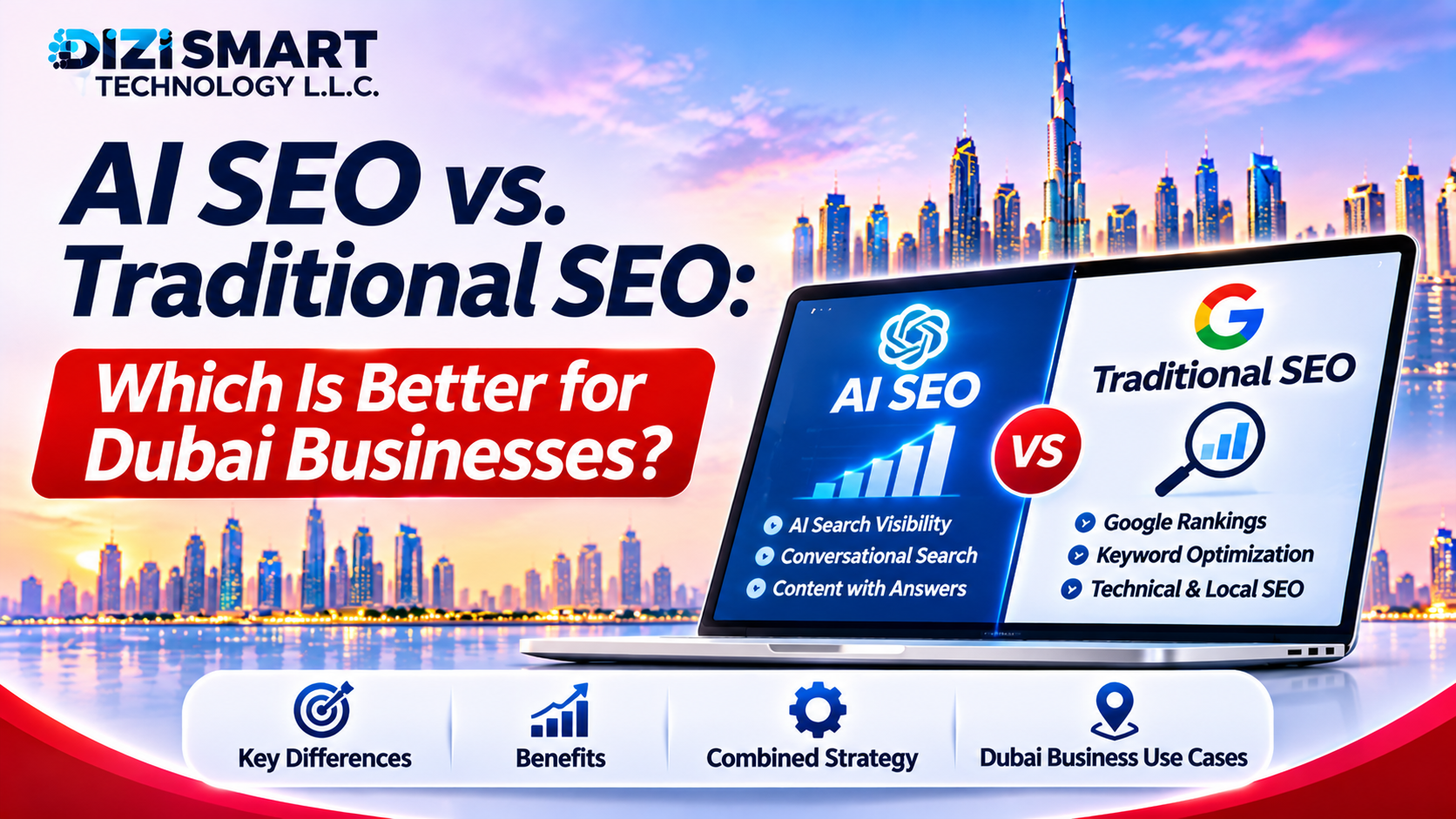
AI SEO vs Traditional SEO: What UAE Businesses Need to Know in 2026
Businesses across the United Arab Emirates are adapting to a changing digital landscape. From Dubai's real estate and hospitality sectors to Sharjah's small businesses and Abu Dhabi's professional services, companies increasingly depend on online visibility to attract customers and remain competitive.
Search engine optimisation (SEO) has traditionally helped businesses appear in Google search results. Today, artificial intelligence is changing how people discover information, compare service providers and research purchasing decisions. AI-powered search experiences are creating new opportunities for businesses to make their expertise and services discoverable online.
This raises an important question: should UAE businesses invest in traditional SEO, AI SEO or both?
The most practical answer is to combine them. Traditional SEO provides the technical and content foundation, while AI-focused optimisation helps businesses prepare their information for discovery through relevant AI-assisted search experiences.
Understanding Traditional SEO
Traditional SEO is the process of improving a website's visibility in organic search results. It involves understanding what customers search for, creating useful pages, improving website performance and helping search engines access and interpret content.
For example, a customer in Dubai might search for a website design company, a property management service or a digital marketing agency. Businesses with relevant, well-structured and helpful pages have an opportunity to reach those potential customers.
Traditional SEO generally includes keyword research, on-page optimisation, technical SEO, content development, local SEO and authority building.
Technical SEO ensures that search engines can crawl and index important pages. On-page SEO improves titles, headings, internal links and page content. Local SEO helps eligible businesses improve their visibility for location-related searches.
These activities remain essential because a website needs a strong foundation before it can consistently attract relevant organic traffic.
What Is AI SEO?
AI SEO describes two related practices: using artificial intelligence to improve SEO workflows and improving website content for discovery through AI-powered search experiences.
AI tools can help marketers organise keyword research, identify content gaps, analyse customer questions, review page structure and prepare content outlines. Human expertise remains important for checking facts, adding original insights and ensuring that published material meets customer needs.
AI-focused search optimisation also involves presenting information clearly. A website should explain what a business offers, which customers it serves, where it operates, how its services work and what makes its expertise credible.
For instance, a UAE technology company could publish a detailed guide explaining how businesses select website development services, what affects project costs and which questions to ask before hiring a provider.
Clear explanations, accurate facts and useful supporting evidence make the content more valuable to readers and easier for search systems to interpret.
However, no AI SEO technique guarantees that a business will be mentioned in ChatGPT Search or another AI-generated answer.
Key Differences Between AI SEO and Traditional SEO
Traditional SEO focuses heavily on organic search visibility, relevant keywords, website structure, technical accessibility and useful content.
AI SEO builds on many of the same principles while placing additional emphasis on clear answers, comprehensive topic coverage, reliable business information and visibility across relevant AI-assisted discovery channels.
There is considerable overlap between the two approaches. Helpful content, accurate information, a technically accessible website and a trustworthy business reputation can support both.
The important distinction is not that one replaces the other. It is that businesses should adapt their existing SEO strategy to account for how customers discover and evaluate information across different platforms.
Why Traditional SEO Still Matters in the UAE
Traditional SEO can help businesses reach people who are actively searching for their products or services.
A Dubai property consultancy may need location-specific property pages. An e-commerce store may need optimised product and category pages. A professional services company may need detailed service descriptions that explain its expertise and process.
A strong traditional SEO strategy helps businesses organise these pages, address search intent and improve their chances of appearing for relevant queries.
It also provides measurable information through tools such as Google Search Console, which reports search impressions, clicks and query performance.
For businesses with limited marketing budgets, prioritising technical issues, important service pages and local search visibility can be a sensible starting point.
How AI SEO Can Support Business Growth
AI-assisted workflows can make some marketing tasks more efficient. For example, AI can help a team group related search queries, identify unanswered customer questions and create a structured content plan.
It can also assist with reviewing long articles for clarity and identifying areas where an explanation needs more detail.
Businesses can use these capabilities to develop content that addresses real purchasing questions rather than simply publishing articles around isolated keywords.
AI search visibility is another area to monitor. Depending on the platform, businesses may be discovered through conversational queries, AI-generated summaries or references to useful online sources.
The outcome depends on many factors, including the platform's systems, the relevance of the content and whether the information is accessible. AI tools should therefore be treated as part of a broader marketing strategy rather than a shortcut to rankings.
Practical SEO Strategies for Dubai and UAE Businesses
1. Build useful service pages
Each important service page should explain what the business provides, who the service is for, which locations it serves and how a potential customer can get started.
Include original examples, relevant project information and clear contact options. Avoid making unsupported claims about results or experience.
2. Research real customer questions
Use search data, sales conversations and customer enquiries to identify topics that matter to your audience.
A website development company might address website costs, e-commerce platforms, website maintenance and mobile usability. A local service provider might answer questions about coverage areas, appointment processes and pricing factors.
3. Improve technical website quality
Check whether important pages can be crawled and indexed. Review broken links, redirect issues, mobile usability, page speed and duplicate content.
Use Google Search Console to investigate indexing and search performance. Use appropriate performance testing tools to identify issues affecting page experience.
4. Strengthen local SEO
Eligible businesses should maintain accurate business information and an up-to-date Google Business Profile. Keep contact details, opening hours, service information and website links consistent.
Create location pages when they provide genuine information for customers in those areas. Publishing many nearly identical pages that only change the city name is unlikely to provide lasting value.
5. Publish original, trustworthy content
Articles should provide more than a generic overview. Include practical examples, reliable references, expert explanations and relevant information that helps readers make decisions.
AI can assist with research and drafting, but the final content should be reviewed for accuracy, originality and usefulness.
6. Make business information easy to understand
Clearly identify the business, its services and the locations it genuinely serves. Provide accessible contact details and explain relevant qualifications, processes and project experience.
Use structured data where appropriate and ensure that it accurately reflects the information visible on the page. Structured data does not guarantee rankings or AI citations.
7. Measure business outcomes
Rankings and traffic are useful indicators, but they do not tell the whole story. Track enquiries, phone calls, form submissions and other meaningful conversions.
Google Analytics 4 and suitable conversion tracking can help businesses understand whether their marketing efforts generate relevant leads. Where measurable, AI referral traffic can provide additional insight into emerging discovery channels.
Common Mistakes Businesses Should Avoid
One common mistake is publishing large volumes of AI-generated content without meaningful review. Repetitive articles that provide little original value may fail to satisfy customers and can conflict with search engine spam policies.
Another mistake is expecting immediate rankings. Search engines need time to discover and evaluate changes, and competitive markets can require sustained work.
Businesses should also avoid keyword stuffing, fake reviews, fabricated case studies and low-quality paid link schemes. These practices can damage credibility and create search policy risks.
Finally, AI SEO should not be measured only by whether a business appears in a particular AI answer on one occasion. Search results can vary, so businesses should use consistent monitoring alongside established search and conversion metrics.
A Practical 90-Day SEO Roadmap
During the first month, audit the website, investigate indexing issues, identify priority keywords and establish a baseline for traffic and leads.
During the second month, improve key service pages, strengthen internal linking, update local business information and publish useful supporting content.
During the third month, review performance, improve underperforming pages and assess whether the business is receiving relevant referral traffic from AI-powered search experiences.
The roadmap should be adjusted according to the website's existing condition, available resources and competitive environment. It is a framework for implementation, not a guarantee of rankings within 90 days.
Conclusion
AI SEO and traditional SEO should not be treated as opposing strategies. Traditional SEO provides the technical, content and local visibility foundations that businesses need, while AI-focused optimisation helps them adapt to new ways people discover information.
For businesses across Dubai and the wider UAE, the best starting point is a technically sound website, useful service pages, accurate business information and content that genuinely answers customer questions.
By combining these fundamentals with thoughtful use of AI and consistent performance measurement, businesses can build a more resilient digital presence as search behaviour evolves.
Related Blog





















6ad6096d44d50.jpg)




6ad1c7874e895.png)



6acdefb0a58d8.jpeg)
















6ab301e068635.jpg)















6aa847276cd93.png)








6a9fa7a209e73.jpg)




6a98551d6c9c3.png)
































6a7b248dbcf8b.jpeg)










6a6350a4893cb.png)

6a606c6a4b011.jpg)












6a50e9b09fb4e.jpg)















6a2bcd56d8f33.jpg)
6a2c0d1d309d3.jpg)

6a211cc2a7dc0.png)

6a18313161c5a.jpg)



























69cb4b7827b08.webp)

























694fa33ac18ea.jpeg)





693e715695a8f.png)


693923523a9ac.png)





68ec9e22634a4.png)


















68edf1fee9090.jpg)















68f0a0f5a49dc.png)













69dcdb1cbe702.jpg)
6aed985f6b5b8.webp)